

Hey there! As a supplier of Brushless DC Motors, I often get asked about all sorts of technical stuff related to these motors. One question that pops up quite a bit is, "What is the electrical time constant of a Brushless DC Motor?" Well, let's dive right into it and break it down in a way that's easy to understand.
First off, let's talk a bit about Brushless DC Motors in general. These motors are pretty awesome. They're used in a wide range of applications, from e - bikes to industrial equipment. Unlike traditional brushed DC motors, they don't have brushes, which means less wear and tear, better efficiency, and a longer lifespan.
Now, onto the electrical time constant. The electrical time constant, usually denoted as τ (tau), is a measure of how quickly the electrical current in the motor reaches its steady - state value when a voltage is applied. In simpler terms, it tells us how fast the motor responds to changes in the electrical input.
Mathematically, the electrical time constant is calculated as the ratio of the motor's inductance (L) to its resistance (R), i.e., τ = L/R. The inductance is a property of the motor's coils that resists changes in the current flow, while the resistance is the opposition to the flow of electrical current.
Let's think about it in a real - world scenario. Imagine you're riding an e - bike with a 48v 60V Electric 500W Brushless DC Motor. When you twist the throttle, you're applying a voltage to the motor. The electrical time constant determines how quickly the motor's current will increase to the level needed to start moving the bike. A smaller time constant means the motor can respond more quickly, so you'll feel a more immediate acceleration.
On the other hand, if the time constant is large, the current will take longer to reach its steady - state value. This might result in a bit of a delay when you try to speed up. But it's not all bad. A larger time constant can also mean that the motor is more stable and less likely to experience sudden current spikes, which can be beneficial in some applications.
For our e - bike example, a motor with a well - balanced electrical time constant is ideal. You want it to respond quickly enough when you need a burst of speed, but also be stable enough to avoid any jerky movements.
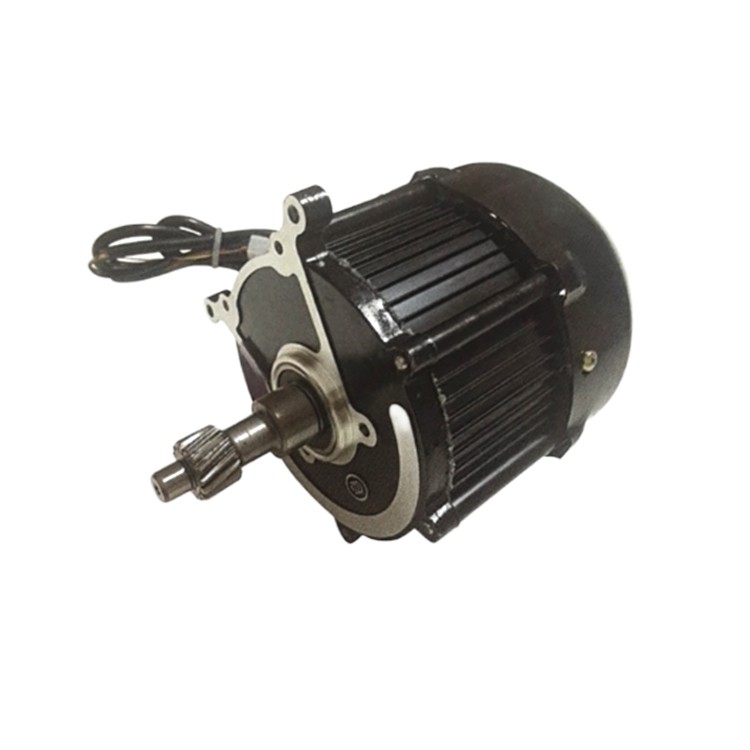

Now, let's talk about how the electrical time constant affects the performance of different types of Brushless DC Motors. For high - power motors like the 48v 60V Electric 1000W Brushless DC Motor, the inductance and resistance values are carefully designed to achieve the right balance. A high - power motor needs to be able to handle large currents, so the resistance is usually kept relatively low. However, this can increase the inductance, which in turn affects the time constant.
In industrial applications, the electrical time constant can also play a crucial role. For example, in automated machinery, the motor needs to start and stop precisely at the right times. A motor with a short electrical time constant can respond quickly to control signals, allowing for more accurate positioning and faster operation.
Another type of motor we offer is the 24V 450W Permanent Magnet Synchronous Motor Ebike. This motor is a bit different from a traditional Brushless DC Motor, but the concept of the electrical time constant still applies. The permanent magnets in this motor create a strong magnetic field, which affects the motor's electrical characteristics. The time constant of this motor is designed to optimize its performance for e - bike use, providing a smooth and efficient ride.
When it comes to choosing the right Brushless DC Motor for your application, understanding the electrical time constant is essential. You need to consider factors like the required acceleration, the load on the motor, and the control system you'll be using. If you need a motor that can start and stop quickly, you'll want one with a smaller electrical time constant. But if stability and smooth operation are more important, a larger time constant might be better.
As a supplier, we have a team of experts who can help you select the right motor based on your specific needs. We understand that every application is unique, and we're committed to providing you with the best possible solution. Whether you're building an e - bike, an industrial machine, or any other device that requires a Brushless DC Motor, we've got you covered.
If you're interested in learning more about our motors or have any questions about the electrical time constant or other technical aspects, don't hesitate to reach out. We're here to help you make the right choice and ensure that your project is a success.
So, if you're in the market for a high - quality Brushless DC Motor, get in touch with us for a friendly chat and let's discuss your requirements. We're eager to work with you and provide you with the perfect motor for your needs.
References:
- "Electric Motors and Drives: Fundamentals, Types and Applications" by Austin Hughes and Bill Drury.
- "Brushless Permanent - Magnet and Reluctance Motor Drives" by Tim Miller.


