

Hey there! As a supplier of brushless DC motors, I often get asked about all sorts of technical stuff related to these motors. One question that pops up quite a bit is, "What is the back - EMF in a brushless DC motor?" So, I thought I'd write this blog to break it down in a way that's easy to understand.
Let's start with the basics. First off, what's an EMF? EMF stands for electromotive force. It's kind of like the "push" that makes electrons move in a circuit. You can think of it as the voltage that causes a current to flow. When we talk about back - EMF, it's a bit different. The back - EMF is an electromotive force that opposes the change in current in an electrical circuit.
In a brushless DC motor, things get a bit more interesting. A brushless DC motor works on the principle of electromagnetism. Inside the motor, there are coils of wire (stator windings) and permanent magnets (rotor). When you apply a voltage to the stator windings, a magnetic field is created. This magnetic field interacts with the magnetic field of the permanent magnets on the rotor, causing the rotor to spin.

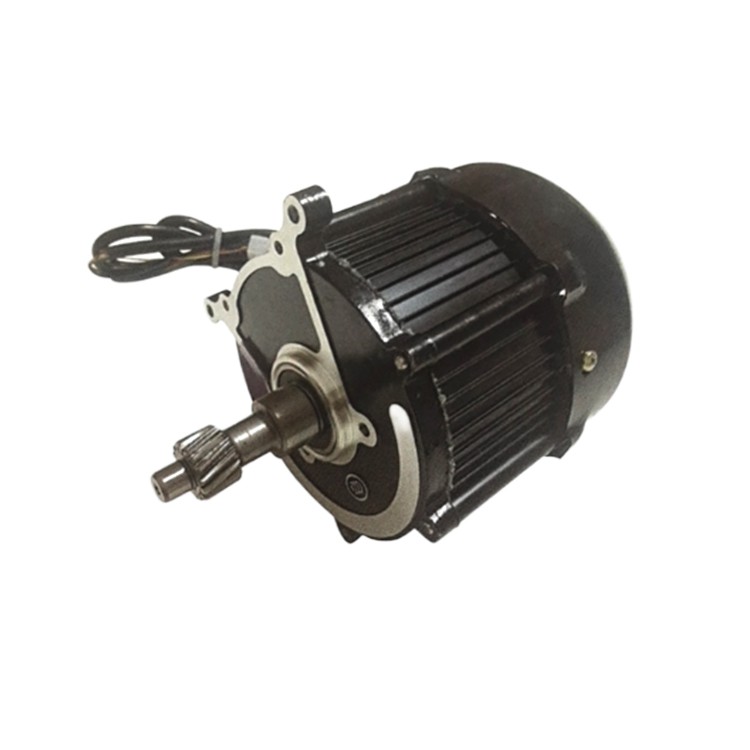
Now, here's where the back - EMF comes in. As the rotor spins, the magnetic field of the permanent magnets passes by the stator windings. According to Faraday's law of electromagnetic induction, a changing magnetic field through a coil of wire induces an electromotive force in that wire. This induced electromotive force is the back - EMF.
The back - EMF has a few important characteristics. First of all, its magnitude is proportional to the speed of the motor. The faster the motor spins, the stronger the back - EMF. This is because a faster - spinning rotor means a more rapidly changing magnetic field passing through the stator windings. Mathematically, we can express the back - EMF (E) as E = k * ω, where k is a constant that depends on the motor's design (like the number of turns in the stator windings and the strength of the permanent magnets), and ω is the angular velocity of the rotor.
Why is the back - EMF important? Well, it plays a crucial role in the operation and control of the brushless DC motor. One of the main functions of the back - EMF is to limit the current flowing through the motor. According to Ohm's law, the current (I) in a circuit is given by I=(V - E)/R, where V is the applied voltage, E is the back - EMF, and R is the resistance of the stator windings. As the motor speeds up, the back - EMF increases. This means that the difference between the applied voltage and the back - EMF decreases, and so does the current flowing through the motor.
This self - regulating effect of the back - EMF is really useful. It helps prevent the motor from drawing too much current, which could damage the motor or the power supply. It also allows the motor to operate more efficiently. When the motor is running at a steady speed, the back - EMF balances out a significant portion of the applied voltage, and only a small amount of current is needed to keep the motor spinning.
Another important aspect of the back - EMF is its use in motor control. Many brushless DC motor controllers use the back - EMF to determine the position of the rotor. Since the back - EMF is generated as the rotor spins, the shape and timing of the back - EMF waveform can provide information about the position of the rotor relative to the stator windings. This information is then used to control the switching of the power to the stator windings, ensuring that the motor runs smoothly and efficiently.
Now, let's talk a bit about how the back - EMF affects the performance of our brushless DC motors. At our company, we offer a range of high - quality brushless DC motors, like the 48v 60V Electric 1000W Brushless DC Motor, the 48v 60V Electric 500W Brushless DC Motor, and the 48v 60V Electric 800W Brushless DC Motor.
The back - EMF affects the starting and running characteristics of these motors. When you first start a brushless DC motor, the back - EMF is zero because the rotor isn't spinning yet. So, the current drawn by the motor is relatively high at startup. As the motor speeds up, the back - EMF increases, and the current decreases. This is why you might notice that a motor draws more current when it's starting up compared to when it's running at a steady speed.
In terms of efficiency, the back - EMF helps our motors run more efficiently. By limiting the current, it reduces the amount of power wasted as heat in the stator windings. This means that more of the electrical power input is converted into mechanical power output, which is what you want in a motor.
If you're in the market for a brushless DC motor, understanding the back - EMF can help you make a better choice. For example, if you need a motor that can handle high - speed operation, you'll want to look for a motor with a design that can manage the higher back - EMF at high speeds.
We're always here to help you choose the right motor for your application. Whether you're working on an e - bike project, an industrial automation system, or something else, our team of experts can provide you with the information and support you need. If you're interested in purchasing any of our brushless DC motors, don't hesitate to reach out. We can discuss your specific requirements, answer any questions you might have, and help you get the best motor for your needs.
In conclusion, the back - EMF is a fundamental concept in the operation of brushless DC motors. It's an electromotive force that opposes the change in current, is proportional to the motor speed, and plays a key role in motor control and efficiency. By understanding the back - EMF, you can better appreciate how our brushless DC motors work and make more informed decisions when it comes to your motor selection. So, if you're looking for a reliable and efficient brushless DC motor, give us a shout, and let's start a conversation about your project.
References:
- "Electric Machinery Fundamentals" by Stephen J. Chapman
- "Brushless Permanent - Magnet Motor Design" by Ned Mohan


