

Hey there, fellow tech enthusiasts and motor lovers! As a supplier of Brushless DC Motors, I've been getting a bunch of questions about how to calculate the power consumption of these motors. So, I thought I'd put together this blog post to break it down for you in a simple and easy-to-understand way.
First off, let's talk a bit about Brushless DC Motors. These motors are super popular because they're more efficient, have a longer lifespan, and require less maintenance compared to traditional brushed motors. They're used in all sorts of applications, from electric bikes to drones and industrial equipment.
Now, onto the main topic: calculating power consumption. The power consumption of a Brushless DC Motor can be calculated using a pretty straightforward formula. Power (P) is equal to the product of voltage (V) and current (I). In mathematical terms, it's written as P = V x I.
Let's say you have one of our 48v 60V Electric 500W Brushless DC Motor. If the motor is operating at a voltage of 48 volts and drawing a current of, say, 10 amps, you can calculate the power consumption like this:
P = V x I
P = 48V x 10A
P = 480 watts
So, in this case, the motor is consuming 480 watts of power. But here's the thing: the actual power consumption can vary depending on a few factors.
One of the main factors is the load on the motor. When the motor is under a heavy load, it has to work harder, which means it will draw more current and consume more power. For example, if you're using the motor to drive a heavy piece of machinery, it'll use more energy compared to when it's running with a light load.
Another factor is the efficiency of the motor. No motor is 100% efficient, which means some of the electrical energy is lost as heat. The efficiency of a Brushless DC Motor is usually expressed as a percentage. Let's say our 500W motor has an efficiency of 80%. This means that only 80% of the input power is converted into useful mechanical power, and the rest is lost as heat.
To calculate the actual power input required to achieve the rated output power, you can use the following formula:
Input Power = Output Power / Efficiency
Using our example, if the output power of the motor is 500W and the efficiency is 80% (or 0.8 in decimal form), the input power would be:
Input Power = 500W / 0.8
Input Power = 625 watts
So, even though the motor is rated at 500W, you need to supply 625 watts of power to it to get that output, due to the losses in the motor.
Now, let's take a look at another example with our 48v 60V Electric 800W Brushless DC Motor. Suppose the motor is operating at 60 volts and drawing a current of 15 amps. Using the power formula, we can calculate the power consumption:
P = V x I
P = 60V x 15A
P = 900 watts
Again, this is the instantaneous power consumption at that particular moment. The actual power usage can change based on the load and the motor's efficiency.
If the efficiency of this 800W motor is 85% (or 0.85), we can calculate the input power needed to achieve the rated output power:
Input Power = Output Power / Efficiency
Input Power = 800W / 0.85
Input Power ≈ 941.18 watts
As you can see, the input power is higher than the rated output power because of the efficiency losses.
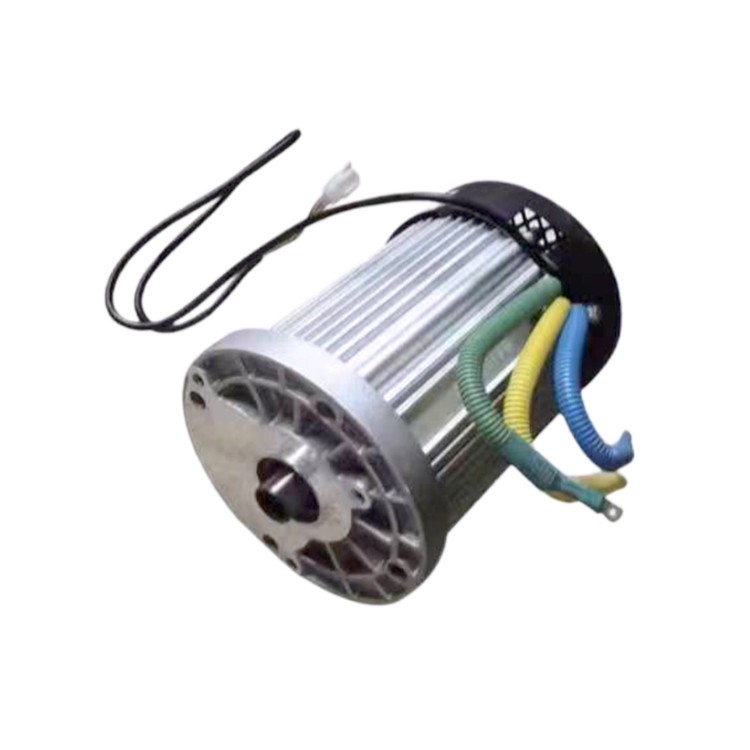
For our 48v 60V Electric 1000W Brushless DC Motor, the same principles apply. Let's say it's running at 48 volts and drawing 22 amps. The power consumption would be:

P = V x I
P = 48V x 22A
P = 1056 watts
And if the efficiency of this motor is 90% (or 0.9), the input power required for the rated 1000W output would be:
Input Power = Output Power / Efficiency
Input Power = 1000W / 0.9
Input Power ≈ 1111.11 watts
Calculating the power consumption is not only important for understanding how much energy your motor is using but also for sizing the power supply and battery. If you underestimate the power requirements, your motor may not perform as expected, or it could even damage the power supply or battery.
On the other hand, if you overestimate the power requirements, you'll end up with a larger and more expensive power supply or battery than you actually need. So, getting an accurate calculation is crucial for a cost-effective and reliable system.
If you're still a bit confused or have specific questions about calculating the power consumption of our Brushless DC Motors, don't hesitate to reach out. We're here to help you make the right choice for your application. Whether you're working on a small DIY project or a large industrial installation, we've got the motors and the expertise to support you.
We offer a wide range of Brushless DC Motors with different power ratings, voltages, and features to suit your needs. And we're always happy to have a chat about your requirements and help you find the perfect motor for your project. So, if you're interested in purchasing our motors or have any questions about power consumption, feel free to contact us for a friendly and professional discussion.
References
- "Electric Motors and Drives: Fundamentals, Types, and Applications" by Austin Hughes and Bill Drury
- Various technical documents from motor manufacturers and industry standards organizations.


